Digitally French

Digitally French

Tuesday, June 28, 2016

Snapchat in the Class

Two weeks ago I shared a link from "Education Week Teacher" about using Snapchat in the classroom.  After reading a few more articles, I have decided to use it in 2016-2017.  Then, we will decide whether or not to ever do it again!  LOL.


But first, I still (probably like many of you) need to learn how to use the App.  You can learn how to do anything on YouTube:
https://www.youtube.com/watch?v=8sntEyrviFk
This was a great basic video on how to use the App for someone new to Snapchat - aka ME.

Main Ideas:
1.  Don't add your students!  We don't care what they are doing on Snapchat and our use of snapchat will be more successful if they know we are NOT looking at their stories.   This will be one-way communication.  I believe this is ideal for distancing yourself from potentially inappropriate exchanges.

2.  Have all students with a Snapchat account add you.  They see your story and they can send you assignments without you having to see their stories.

3.  Don't make snapchat accounts a mandatory element to the curriculum.  Group work can still be done and assignments turned in with only one person in the group who has an account.  Viewing your story will therefore be an additional resource to enhance lessons and to review taught material.

4.  If you choose to use Snapchat in the class - make it classroom only.  Leave your family life out of it.  For example:  I personally use Facebook for family, Instagram for my hobbies and blogs, Twitter for my students and my professional development, and now Snapchat for classroom enhancement.


Here is a great link from a Spanish Teacher with ideas that could apply to any curriculum:
http://ditchthattextbook.com/2016/04/11/15-ways-to-use-snapchat-in-classes-and-schools/

My Favorite Ideas: (But read the whole article if you are getting interested in using Snapchat next year)
1.  Use your story for "Test Review."

2.  Use your story for reminders!

3.  The Virtual Study Session:  Create a 10 snaps in your story with the top things to remember before a quiz or test.

4.  10 second Movies: Students can create a 10 second movie about a key concept and then can send it to you.  Great application lesson.

5.  Student Take-Over:  Awesome Idea.  With strict guidelines, allow students to take over your account and create a story to share with all of your followers using only the target language.

6.  Speech Bubbles:  Students can take a picture and add a speech bubble in the target language and send it to you.

And my own idea:
1. Student speaking practice in 10 seconds or less and send to the teacher...not viewable by anyone else...and private!


Need More Ideas:  Just go to PINTREST...holy moly!

Need more convincing:  watch these language learning samples
https://www.youtube.com/watch?v=ZiWLuWlr_5I


There!  
Now, follow me on Snapchat!
stillingsfrench


Tuesday, June 14, 2016

Teachers are starting to use Snapchat...should I?...should You?

Pondering this question during my first week of summer vacation and how it could enhance/hurt, make me better/stress me out more for the next school year.  Read the story and decide for yourself:

http://blogs.edweek.org/teachers/teaching_now/2016/06/teachers_snapchat_guide.html?qs=math


Tuesday, January 26, 2016

Vocabulary Ladder - Game Based LEARNING!

The age-old question:  How do you make learning more engaging?  The answer I support: when learning feels like "play."  Game-Based learning is a curriculum design that I have championed ever since attending a workshop last summer with The Institute of Play.  The hardest new concept for educators to accept  is HOW to make the learning (not the review) feel like play rather than utilizing "teacher input."  There are a couple of concepts advocated by The Institute of Play that I used to design this vocabulary teaching game: Vocabulary Ladder.  Here are the rules to the game in which students LEARN new vocabulary in a fun and engaging manner.


Divide the class into teams of 3-4 students.

1.  It kinda feels like play:  The goal of the game is to be the first team to make it to the end of the  "Candy Land" - like map.

2.  Everyone is a participant: Each member has a role to play.  One person is in charge of writing their answer choice on a personal white board and holding it up when time is called, The Writer.  Another member is in charge of defending and explaining why they chose the word, The Lawyer.  Then someone is in charge of rolling the dice, Dice Roller  The final person (and in groups of three the dice roller can double up and do this) is the Place Mover and travels to the front of the room to move the game piece.

3.  Failure is reframed as iteration:  As I listen to various arguments, I praise their ability to look at loan words or cognates even if their choice is wrong.

4.  Learning happens by doing:  I pick about 15-18 never seen before vocabulary words from a new unit and place them into a Power Point.  I then give them about 5 translations to choose from.  Students have to guess the definition to the new word based on prior knowledge, loan words, perhaps something they have seen before in another class, etc.... and be prepared to defend their choice.


5.  Challenge is constant:  Words must be new so that students are having to rely on cognition skills to learn the vocabulary, rather than just memorize.  This is not a review game but rather a learning game where meaning for the new words is created immediately when their groups try to logically predict and then justify meaning.  To prevent one team from having an advantage, teams with correct answers get to roll a dice to determine how many spaces to move forward.  So, at any time, it is still anyone's game as a perfect 6 could be rolled or a 1 could be rolled.  Also, on the game board their is a ladder indicating a backwards move.  If the team rolls and lands on this block they move back a row.

6.  Feedback is immediate:  The correct answer is revealed after all the Lawyers have presented their case.  Then, only the groups with the correct responses get to roll the dice and move forward the same number of spaces on the game board.

7.  Everything is interconnected:  Students have fun using material they have seen on television, heard in science class, "it looks like this..."  The meaning of the vocabulary is created instantly without any teacher input.


How to Make A Game Board:
Using painter's tape, make a "Candy-Land" like board.  This one was made on a white vinyl table cloth purchased at Walmart.  Once I mapped out the route, I used a sharpie to draw in the boarders.  Include a slide down and a slide up to keep the game interesting and random.


The game pieces (stuffed animals) were purchased at the dollar store along with a pack of dice.  


For more great ideas check out my store:  https://www.teacherspayteachers.com/Store/Digitally-French?aref=6n02igd7


Monday, November 2, 2015

BOOM Bag!

I came across this review game from a peer and have adapted it for the World Language Class.  I had great success using it for some more Game Based Learning.  Here are the initial rules:


In pairs, students will face off in a competition.  Student A will close their eyes, reach into the paper bag that Student B is holding, pull out a slip with a question, and hand it to Student B.  Student B will read aloud the question for Student A to answer.  If Student A answers correctly, then they get to keep the slip of paper and count it as a point; if they get it wrong, it goes back into the bag.  If Student A had drawn out a slip that said 'Boom!' then they would be required to put all of the slips they had collected from previous rounds back into the bag and start from 0.  Students will take turns and the student with the most points wins.

I love this because every participant is active, questions do get repeated as students put wrong answers or "Boom" answers back into the bag, mistakes get reframed as iteration, learning feels like play, you can play it on multiple days, and it allows for peer assessment.

I used this two different ways:
1.  I reviewed for French One's midterm with 45 different questions typed up and 6 Booms.

2.  I also used this for French Three to practice Passé Composé and Imparfait.  I typed up 13 Imparfait translations, 14 Passé Composé questions, 4 Booms, and 13 questions where they had to choose the difference between the two tenses.  Students played on day one with their notes, and then without their notes on day two for Game Based Learning.  I added the use of the white boards to allow students to write out the correct formations.


My Passé Composé, Imparfait version is available and ready to print on my store:

Wednesday, October 14, 2015

Croquembouche! The Team Building Challenge

What do you do when your classroom is being used to administer the 10th grade PLAN and you have been told to relocate to the Foods classroom downstairs?  Create a Traditional French Wedding Cake (Croquembouche) tower build off!

Supplies:  Pre-made cream puffs purchased from the freezer section (I had students purchase them)
       Make a caramel sauce (I used 2.5 cups sugar with 2/3 cups of water, boil, then cool)

Rules:


  1. Divide the class into two teams and give them the same amount of cream puffs.  For us this was one box of 33 puffs.
  2. Give each team a bowl of hot caramel sauce.
  3. Set the timer at 10 minutes.
  4. The team with the tallest, hollow center, free-standing tower wins.

Additional Challenge:
   The whole class or team has to yell "Croquembouche" when

  • anyone enters the room
  • anything falls on the floor
  • a cream puff falls from the tower
  • when your team finishes the tower and you are done


At the end of the day, this was a fun, team building, problem solving activity to discuss what a Traditional French Wedding Cake looks like, taste like, and how its made!! Game On!

Saturday, October 3, 2015

Go Fish - Reflexive Verbs In Future Tense

The importance of PLAY TESTING!!  This game started out as an idea...I wanted to adapt Go Fish to apply writing reflexive verbs in the near future (futur prôche).  So, I created a deck of cards where students had to match a "book" of four to complete a match "Je vais me browser."  Then, I "play tested"  and most importunity, asked the kids for feedback on how to make this better.  The end result after two full days of "play testing" was a version where students could not stalemate each  other, and I could keep track of who was winning for extra credit.  They love this game.  I then used the same deck of cards and created supplemental cards to alter the game for Passé Composé.


Allez À La Pêche - Rules
The goal is to create a phrase of 4 in agreement: Je vais me coucher.
The student with the most phrases wins.

For 2 players:  Deal 7 Cards
     3 players:  Deal 6 Cards
    4 players:   Deal 5 Cards  (Best arrangement)
     5 players:  Deal 4 Cards
All other cards go in the middle.

Similar to go fish, ask a player if they have a certain card that would complete a phrase.  If you have a 'Je' you could ask for a 'me.'  If that player has the card they give it away and you would go again.  If that player does not, they would say "Allez À La Pêche."  If you run out of cards because other people have taken them, you re-deal cards from the pile.  "Libre" cards are free to be whatever, similar to a wild card.  Once you get three of a "book" you can set those aside to protect them from being taken, but then you may not take them back later to use for another "book."  This prevents stalemating a player by exchanging the same card back and forth.  Record completed "books" of four on the team page.  The player who has the most correct phrases wins and the teacher can use that sheet as formative assessment or can use those points as extra credit. 


The red cards can be substituted to create a similar game for Passé Composé.


*I printed off six sets of these cards in different colors of card stock to create a classroom set that was easy to keep organized.  I also kept the Passé Composé cards separate also.


The entire file complete with playing cards, a formative check sheet while students are playing, color coded guided notes, and a final assessment for Reflexive Verbs in present, future, and past tense
is available on my store:

Thursday, October 1, 2015

Picture Talk - The Game

Picture Talk is another great use of Game Based Learning.  Rules to following when designing a "game lesson" :  Everyone is a participant, Learning happens by doing, It feels like play, Opportunities exist for students to fail and the teacher can reframe, Feedback is immediate, Challenge is constant, Everything is interconnected.

Picture Talk Rules:
  1. One describer comes to the front of the room.
  2. The describer looks at the pre-drawn image.  They instruct the class on how to draw the image without saying what exactly to draw.  For a shapes lesson the student could only use shapes, dimensions, and locations.  For identifying objects, student could only mention object and its location in the TL.
  3. The copiers (students) are not allowed to speak.
  4. When all copiers are finished the drawer reveals the image to see how many copiers (students) got it right.


On the left are the three images I used for French Three and their lesson on shapes and dimensions.  The right side is the images I used for French One in their lesson on objects and directions.

The modification I made was that the drawer could only use French!  Even at the novice low level, this was doable and assessed speaking skills and listening skills.

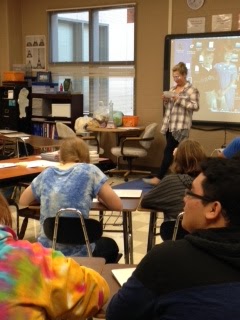
Alyssa leading the picture talk of the chair scene.


Lesson Roll Out:
1.  I modeled the first drawing.
2.  I asked for student volunteers to lead the next few drawings.
3.  Then I divided the class into two teams to compete against each other.  Each team had a poster and a pack of markers.  Taking turns, one member from each team draws the object on the poster in its correct color.  Points are awarded to the team/teams who correctly draw the item.  The team with the most points at the end of the game is the winner.

To end the activity with a competition, the teams competed in drawing the objects in the correct color and in the location I mentioned : On the table, there is a blue cellphone.